H05V-U, H05V-R and H05V-K Comparison: Conductor Construction Differences
H05V-U, H05V-R and H05V-K are compared by conductor construction, bending information and stated application contexts. Harmonised product codes are used for global content.

Technical Comparison
 | 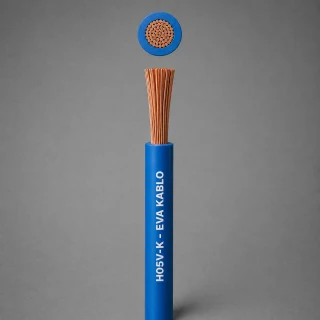 | 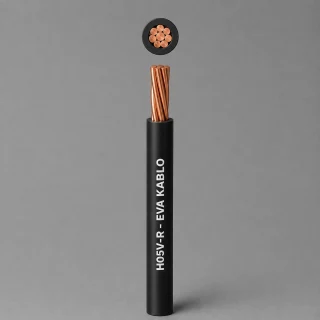 | |
|---|---|---|---|
| Technical Attribute | H05V-U — NYA Kablo | H05V-K — NYAF Kablo | H05V-R — Çok Telli NYA Kablo |
| Conductor construction | Solid Copper Conductor | Stranded Copper Conductor | Fine-Stranded Conductor |
| Insulation | PVC | PVC | PVC |
| Insulation type | PVC(TI1) | PVC(TI1) | PVC(TI1) |
| Construction standard | TSE EN 50525-2-31; TSE IEC 60227; VDE 0281 | TS EN 50525-2-31; TSE IEC 60227; VDE 0281 | TSE EN 50525-2-31; TSE IEC 60227; VDE 0281 |
| Conductor resistance standard | TS EN 60228 | TS EN 60228 | TS EN 60228 |
| Rated voltage | 300/500 V | 300/500 V | 300/500 V |
| Test voltage | 2-2.5 kV | 2-2.5 kV | 2-2.5 kV |
| Minimum bending diameter | 6xD, 12xD | 6xD, 12xD | 6xD |
| Operating temperature | 70 °C | 70 °C | 70 °C |
| Insulation colour standard | TS 9758 | TS 9758 | TS 9758 |
| Flame test standard | TS EN 60332-1-2 | TS EN 60332-1-2 | TS EN 60332-1-2 |
| 0.50 mm²: diameter / weight / delivery length / resistance / current | 2.1 mm / 8 kg / km / 100 m / 36.0 ohm / km / 12 A | 2.1 mm / 8 kg / km / 100 m / 36.0 ohm / km / 9 A | 2.1 mm / 9 kg / km / 100 m / 39.0 ohm / km / 11 A |
| 0.75 mm²: diameter / weight / delivery length / resistance / current | 2.3 mm / 11 kg / km / 100 m / 24.5 ohm / km / 15 A | 2.3 mm / 11 kg / km / 100 m / 24.5 ohm / km / 15 A | 2.3 mm / 11 kg / km / 100 m / 26.0 ohm / km / 16 A |
| 1.00 mm²: diameter / weight / delivery length / resistance / current | 2.5 mm / 14 kg / km / 100 m / 12.1 ohm / km / 19 A | 2.5 mm / 14 kg / km / 100 m / 12.1 ohm / km / 19 A | 2.5 mm / 14 kg / km / 100 m / 19.5 ohm / km / 20 A |
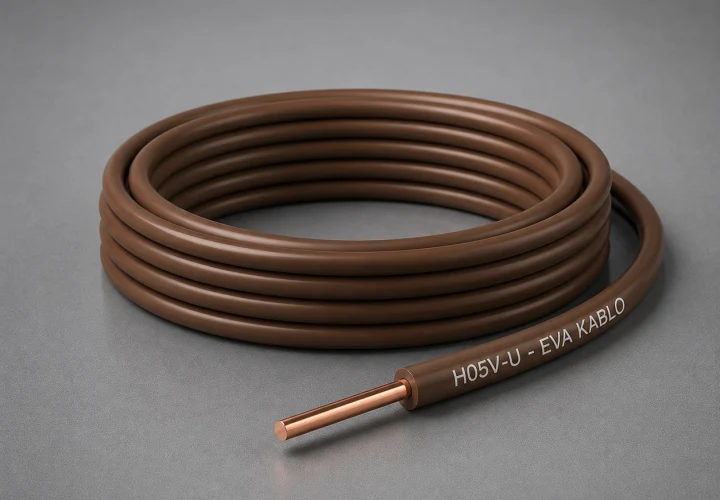
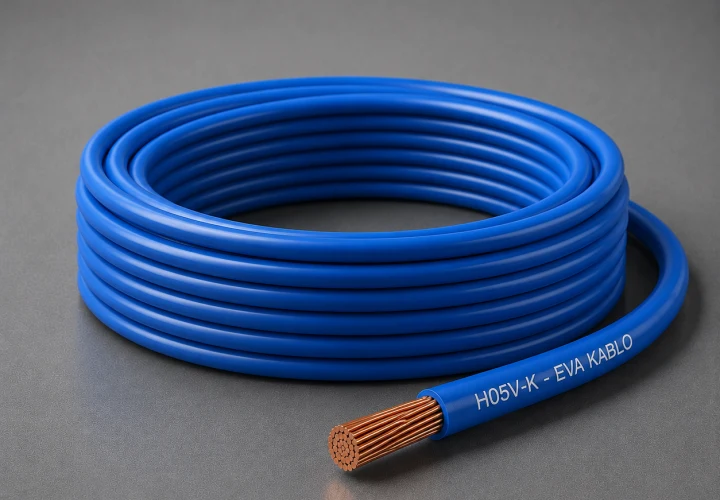
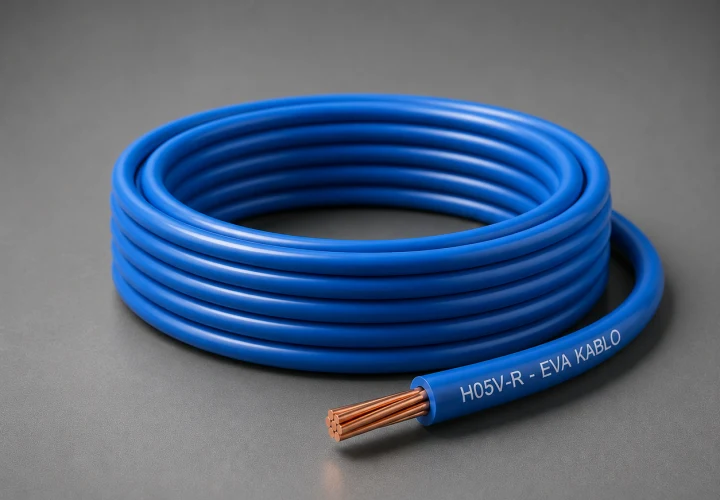
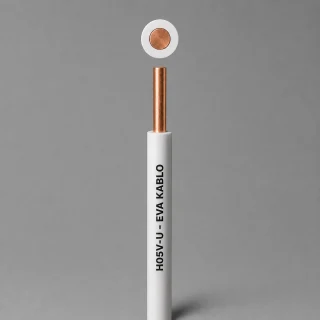
H05V-U, H05V-R and H05V-K are harmonised cables with PVC insulation and a rated voltage of 300/500 V. The principal distinction between the three products is the construction of the copper conductor: H05V-U has a solid conductor, H05V-R has a stranded conductor and H05V-K has a fine-stranded conductor.
This content has been prepared for a global/international market context. Therefore, the products are referred to by their verified harmonised codes. Local market names are not used as global names in this comparison.
Key differences by conductor construction
H05V-U is specified with a solid copper conductor for fixed electrical installations. H05V-R has a stranded copper conductor and is stated for fixed-installation applications. H05V-K uses a fine-stranded conductor and is described as a flexible cable for confined panel and equipment connections.
Common technical information
For all three products compared, the insulation is stated as PVC, the insulation type as PVC(TI1), the rated voltage as 300/500 V and the test voltage as 2-2.5 kV. The operating temperature is 70 °C, the insulation colour standard is TS 9758, and the flame test standard is TS EN 60332-1-2. The conductor resistance standard is specified as TS EN 60228 for all three products.
The construction standard is recorded as TSE EN 50525-2-31; TSE IEC 60227; VDE 0281 for H05V-U and H05V-K, and as TS EN 50525-2-31; TSE IEC 60227; VDE 0281 for H05V-R.
Bending and termination considerations
The minimum bending diameter is given as 6xD, 12xD for H05V-U and H05V-R, and as 6xD for H05V-K. For the fine-stranded construction of H05V-K, using suitable ferrules and terminal equipment at connection ends helps provide orderly termination of the fine strands.
Comparison of cross-section data
The source data contains 0.50, 0.75 and 1.00 mm² cross-section information for all three products. When selecting a cross-section, the installation method, ambient temperature, connection equipment and applicable installation rules should be evaluated together with the current requirement. The current values in the technical table are those stated in the product data and may require further evaluation for different installation conditions.
Selection approach
Product selection should take account of the required conductor construction and the stated installation context. These products should not be presented as direct substitutes for one another.