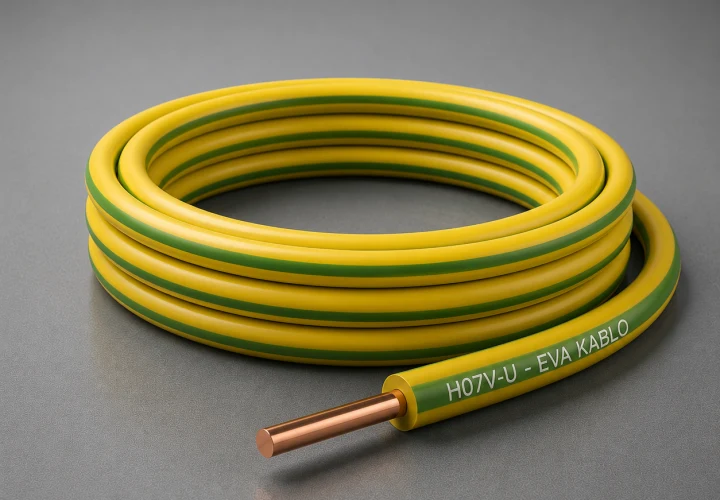
What Is H07V-U Cable and Where Is It Used?
H07V-U is a harmonised 450/750 V fixed-installation wire with a solid copper conductor and PVC insulation, intended for protected installations, panels and fixed lighting circuits.

H07V-U cable is a harmonized fixed-installation cable with a solid copper conductor and PVC insulation. Rated at 450/750 V, this product is manufactured by EVA Kablo for panel and protected building installation applications.
Basic construction of H07V-U cable
H07V-U has a solid copper conductor construction. Its insulation material is specified as PVC(TI1). The conductor resistance standard is TS EN 60228, while the insulation, insulating material, and insulation colour standards fall within the scope of TS 9758.
Where is H07V-U cable used?
H07V-U may be considered for applications requiring fixed and protected installation. Its principal areas of use include main distribution panels, switching and control equipment, building installations in conduit, and fixed lighting circuits.
Because of its solid conductor construction, it is preferred for fixed installation arrangements rather than connections subject to continuous movement or frequent bending. The installation method and application conditions should be considered when selecting the cable.
Why is conductor cross-section selection important?
For H07V-U cable, the appropriate conductor cross-section should be determined by considering the current to be carried, circuit length, voltage drop, installation conditions, and applicable standards. The current-carrying capacity standard for the product is specified as VDE 0100-430.
Available product data include cross-section options of 1.50 mm², 2.5 mm², 4 mm², 6 mm², 10 mm², and 16 mm². The cross-section decision for a specific installation should be made according to project and application requirements.
Bending and installation considerations
The specified minimum bending diameter for H07V-U is 6xD, 12xD. During installation, the cable’s fixed-installation character, in-conduit application conditions, and project requirements associated with the selected cross-section should be considered together.