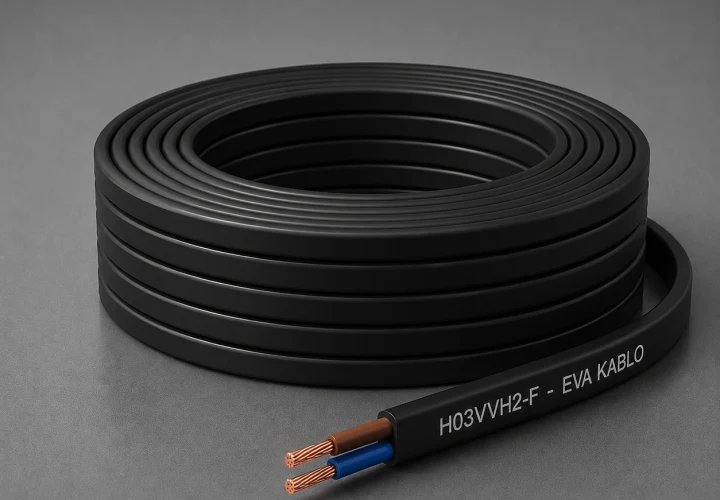
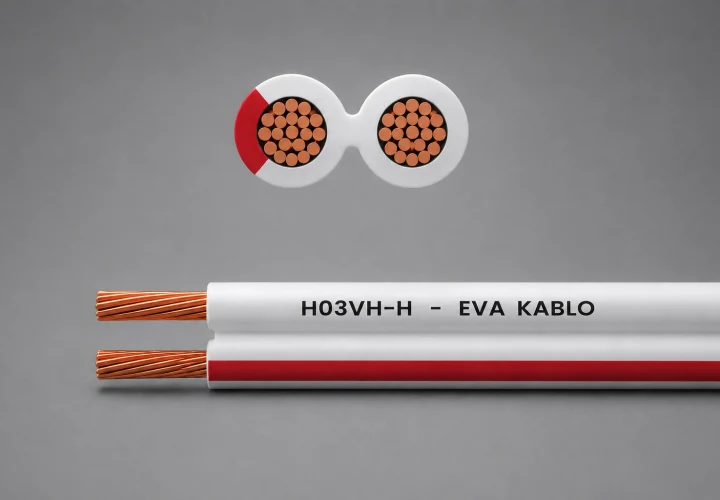
H03VVH2-F vs H03VH-H Comparison
Compare the outer sheath, conductor construction, recorded technical characteristics, and stated application contexts of H03VVH2-F non-separable flat cord and H03VH-H separable flat cord.

Technical Comparison
 |  | |
|---|---|---|
| Technical Attribute | H03VVH2-F | H03VH-H |
| Cable construction | Flat, multicore flexible cable; cores are positioned side by side within a common PVC outer sheath. | Flat, separable flexible cord; two cores are joined side by side without an outer sheath. |
| Outer sheath | PVC outer sheath; PVC(TM2). | No outer sheath. |
| Conductor construction | Fine-stranded copper conductor. | Very fine-stranded copper conductor. |
| Insulation | PVC insulation; PVC(TI2). | PVC insulation; PVC(TI2). |
| Core separation | The cores are used together without being separated from each other. | The connection ends can be carefully separated when required, without damaging the core insulation. |
| Operating voltage (rated voltage) | 300/300 V | 300/300 V |
| Test voltage | 2 kV | 2 kV |
| Minimum bending diameter | 6xD | 6xD |
| Operating temperature | 70 °C | 70 °C |
| Conductor resistance standard | TS EN 60228 | TS EN 60228 |
| Flame test standard | TS EN 60332-1-2 | TS EN 60332-1-2 |
| Construction standard | TS EN 50525-2-11 | Not specified among the recorded characteristics. |
| Stated application context | Light-duty applications in dry, enclosed environments with low mechanical stress; table lamps, small household appliances, decorative lighting, and confined connection areas. | Dry indoor connections with low mechanical stress; table lamps and small household appliances. |
H03VVH2-F and H03VH-H are listed flat flexible cords for light-duty appliance connections. Both products use PVC-insulated copper conductors, but they differ in their outer-sheath construction and whether their cores can be separated. They should therefore not be treated as direct substitutes; selection should consider the connection arrangement and expected mechanical conditions.
Main construction difference
H03VVH2-F: non-separable flat cord
In H03VVH2-F, fine-stranded copper conductors are individually PVC-insulated and arranged side by side within a common PVC outer sheath. Since the common outer sheath encloses the cores together, the cores are used without being separated from one another.
In practice, non-separable means that the two or three cores form one complete cable construction within the common outer sheath along the connection length. Separating the cores into two individual strips from the cable body is not intended during end preparation or routing.
H03VH-H: separable flat cord
In H03VH-H, two very fine-stranded copper conductors are individually PVC-insulated and joined side by side without an outer sheath. Where needed, the connection ends can be carefully separated without damaging the core insulation.
In practice, separable means that the two joined side-by-side cores can be carefully divided into two individual legs at the termination area. This does not mean that the cable is more durable in every service condition or suitable for all connection types.
Outer sheath and conductor construction
The defining construction difference is therefore that H03VVH2-F has a common PVC outer sheath, whereas H03VH-H consists of two side-by-side, separable cores without an outer sheath.
Stated application contexts
H03VVH2-F is specified for table lamps, small household appliances, decorative lighting, and orderly routing in confined connection areas. It is designed for light-duty applications in dry, enclosed environments with low mechanical stress. Its product record states that it should not be used for heavy equipment or in unprotected outdoor environments.
H03VH-H is specified for table lamps, small household appliances, and dry indoor connections subject to low mechanical stress. Due to its unsheathed construction, it is recorded as unsuitable for heavy mechanical impacts, high temperatures, or unprotected outdoor environments.
How should the recorded technical data be read?
For both products, the recorded rated voltage is 300/300 V, test voltage is 2 kV, minimum bending diameter is 6xD, and operating temperature is 70 °C. Both products are recorded with TS EN 60228 as the conductor resistance standard and TS EN 60332-1-2 as the flame test standard. H03VVH2-F additionally has a recorded construction standard of TS EN 50525-2-11.
The H03VH-H product description states that its standard operating voltage is 300/300 V and that cross-sections marked with an asterisk in the technical table are in the 300/500 V class; however, no asterisk is shown in the supplied technical rows. Therefore, the current product technical record should be checked before selecting a different voltage class for a specific cross-section.