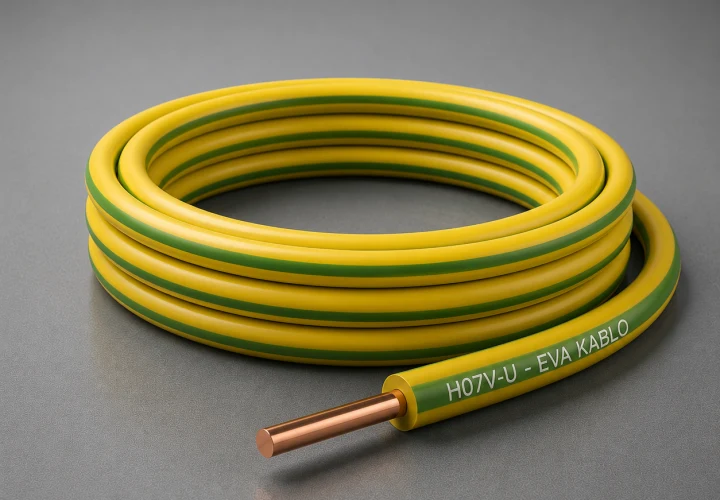
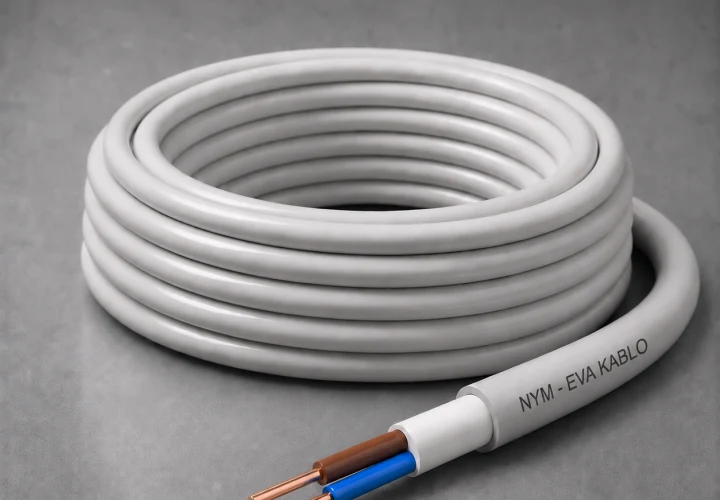
H07V-U vs. NVV (NYM) Cable Comparison
A comparison of the H07V-U single-core, PVC-insulated conductor and the NVV (NYM) multi-core fixed-installation cable with PVC filler and PVC outer sheath, in terms of construction, rated voltage and application approach.

Technical Comparison
 |  | |
|---|---|---|
| Technical Attribute | H07V-U | NVV (NYM) |
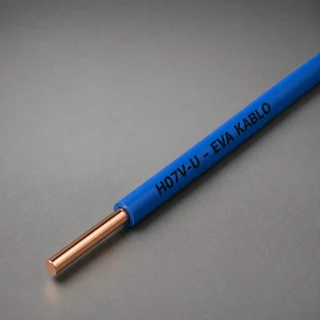
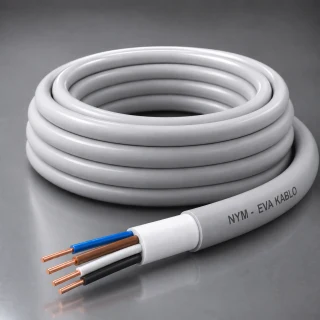
| Product construction | Single-core, PVC-insulated conductor | Multi-core cable with PVC filler and PVC outer sheath |
| Conductor construction | Solid copper conductor | re: solid round copper conductor; rm: stranded round copper conductor |
| Insulation | PVC; PVC(TI1) | PVC insulation; PVC(TI1) |
| Filler | Not specified | PVC filler |
| Outer sheath | Not specified | PVC outer sheath; PVC(TM1) |
| Construction standard | TSE EN 50525-2-31; TSE IEC 60227; VDE 0281 | TS HD 21.4 S2 |
| Conductor resistance standard | TS EN 60228 | TS EN 60228 |
| Rated voltage | 450/750 V | 300/500 V |
| Test voltage | 2-2.5 kV | 2 kV |
| Minimum bending diameter | 6xD, 12xD | 12xD |
| Operating temperature | 70 °C | 70 °C |
| Flame test standard | TS EN 60332-1-2 | TS EN 60332-1-2 |
| Application approach stated in the product record | Fixed and protected installations for panels, switching and control equipment, building installations in conduits, and fixed lighting circuits | Indoor power distribution, fixed installations under or on plaster; routing in a suitable conduit or duct system |
H07V-U and NVV (NYM) are two product types that may be considered for fixed-installation projects, but they do not have the same construction or installation approach. H07V-U is a single-core conductor consisting of a solid copper conductor and PVC insulation. NVV (NYM), on the other hand, is a multi-core fixed-installation cable that combines multiple cores and includes PVC filler and a PVC outer sheath.
The purpose of this comparison is not to present the products as direct substitutes, but to make the selection differences visible in terms of the required core configuration, protection arrangement and installation method.
Structural difference: single-core conductor and sheathed multi-core cable
H07V-U is constructed with a solid copper conductor and PVC insulation. Its product record lists panel and protected building installations, main distribution boards, switching and control equipment, building installations in conduits, and fixed lighting circuits among its application examples.
NVV (NYM) is a multi-core cable. In addition to PVC insulation on the cores, it includes PVC filler and a PVC outer sheath. This construction is considered for fixed-installation applications where multiple cores need to be routed within a single cable body. Its product record gives examples including residential buildings, commercial buildings, workshops, distribution boards, and fixed installations installed under or on plaster.
How do the application approaches differ?
For H07V-U
H07V-U may be considered for panel and protected installation arrangements requiring a single-core conductor solution. Building installations in conduits and fixed lighting circuits are among the applications stated in the product description. It is specified for fixed and protected installations rather than continuously moving or frequently flexed connections.
For NVV (NYM)
With its multi-core, sheathed construction, NVV (NYM) may be considered for indoor power distribution. It can be routed in a suitable conduit or duct system. The product record specifically states that the relevant protection conditions must be provided for direct underground or continuous outdoor applications.
A cable name alone is not sufficient for selection
The 450/750 V rated voltage of H07V-U and the 300/500 V rated voltage of NVV (NYM) are among the differences to consider during selection. However, rated voltage alone is not sufficient for product selection. The required number of cores, conductor cross-section, circuit load, route length, voltage drop, installation method, laying conditions and applicable installation rules should be evaluated together.
Neither product should be regarded as universally suitable for every environment and every installation method. The protection system in the project, the cable route and the application conditions should also be examined.